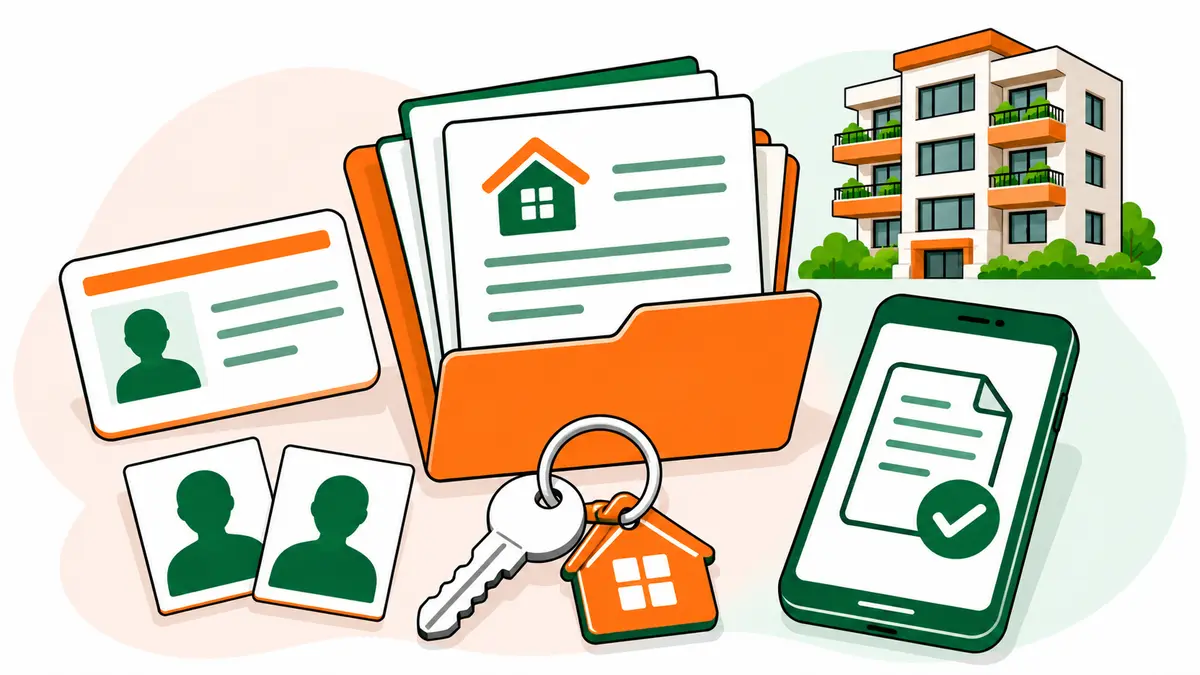
The documents required for rent agreement signing are fairly standard across India. A tenant usually needs identity proof, address proof, passport-size photos, and something that shows they can pay the rent, such as an employment letter, salary slips or a student ID. The owner needs proof that they own the flat and their own ID, and in many cities, the tenant’s details have to be submitted to the police.
The exact list changes with the city, the society and the landlord. For the full renting process, see our complete guide to renting a house in India. This guide covers what each side should have ready, what’s reasonable to share, and the paperwork that protects both of you.
Documents required for rent agreement: the tenant’s list
When you rent a flat, most landlords and brokers ask for a similar set. Keep scanned copies on your phone so you can share them the day you like a flat.
| Document | Why it’s asked for | Notes |
|---|---|---|
| Identity proof | To confirm who you are | Aadhaar, PAN card, passport, voter ID or driving licence |
| Permanent address proof | For the agreement and police verification | Aadhaar, passport, voter ID or a utility bill from your home address |
| Passport-size photographs | For the agreement and police form | Two to four copies |
| Employment proof | To show you can pay rent | Offer letter, company ID card or latest salary slips |
| Student proof (if studying) | Instead of employment proof | College ID or admission letter, often with a parent as guarantor |
| PAN card | For tax purposes and higher rent amounts | Also useful if your employer needs landlord details for HRA |
| Previous landlord’s reference | Some landlords ask for it | A phone number is usually enough |
| Police verification form | Required in many cities | The landlord usually files it, but you fill in your details |
For families, landlords usually want ID for each adult who will live in the flat. For shared flats, every flatmate should be named in the agreement, not just the person paying rent.
Share a masked Aadhaar, not a full copy
Aadhaar is the most requested document, and the one you should be most careful with. UIDAI offers a masked Aadhaar, a downloadable e-Aadhaar that hides the first eight digits of your Aadhaar number and shows only the last four. It works for identity and address proof in most rental situations.
Two more habits help. Write “For rent agreement of [flat address] only” and the date across any ID copy you hand over. And send documents to the landlord directly, not to every broker who asks for them on WhatsApp.
Documents the owner should show before you rent a flat
Tenants who rent a flat often forget that checking the landlord is just as important. Before you pay a deposit, ask to see:
- Proof of ownership: the sale deed, allotment letter, or a recent property tax or electricity bill in the owner’s name.
- Owner’s identity proof: to match against the name on the ownership documents.
- Society permission, if required: some housing societies need a no-objection letter or a form from the owner before a tenant moves in.
- Power of attorney: if someone other than the owner (a relative or agent) is renting the flat out, ask for the written authority.
- Previous bills: the latest electricity, water and maintenance bills, to make sure you aren’t inheriting someone else’s dues.
If the person showing the flat can’t produce any ownership proof, don’t hand over a deposit. Fake “owners” renting out flats they don’t own is one of the oldest rental scams in Indian cities.
Red flags when you check the paperwork
Most rental problems show up in the documents long before move-in day, if you look for them:
- The name on the ownership proof doesn’t match the person you’re dealing with, and there’s no written authority from the real owner.
- The “owner” wants the deposit in cash, or a token amount before showing you the flat.
- The electricity or maintenance bills show months of unpaid dues.
- The landlord refuses to put the deposit amount, notice period or maintenance terms in writing.
- A broker asks for your full Aadhaar, PAN and photos before you’ve even seen the property.
Any one of these is a reason to slow down and ask questions. Two or more, and it’s usually better to keep looking.
The rent agreement itself
Once both sides have the documents, the next paper is the agreement. It should name every adult tenant, list the rent, deposit, notice period and maintenance terms, and include an inventory of fittings. It goes on stamp paper of the value your state prescribes, and it must be registered if the term is longer than 11 months. For registration, the sub-registrar usually also wants ID proof and photos of both parties and two witnesses, plus proof that the stamp duty and registration fee are paid. Your state’s registration department lists the exact documents. In Maharashtra, every leave and licence agreement must be registered regardless of length.
Our full guide to rent agreements in India covers the format, stamp duty and registration step by step.
Police verification of tenants
In many cities, landlords must give the local police the tenant’s details. It helps the police keep track of who lives where, and in some places a landlord who skips it can face action. The tenant normally provides an ID copy, a photo, permanent address and sometimes references, and the landlord submits the form.
Most state police forces now take this online:
- Delhi: through the Delhi Police citizen services portal, with forms also available on the downloads page.
- Uttar Pradesh: through the UP Police citizen services.
- Maharashtra: through the Maharashtra Police citizen portal, with some police commissionerates running their own tenant information forms.
- Tamil Nadu: through the Tamil Nadu Police citizen portal.
For other states, check the state police website or visit the local police station. Keep the acknowledgement once it’s filed. Tenants should ask for a copy too, since some employers and banks ask for proof of current address.
Money paperwork: deposit, rent and receipts
The documents don’t end when you get the keys. A few money records save trouble later:
- Deposit receipt: pay the security deposit by bank transfer and get a written acknowledgement, or make sure the agreement records the amount and how you paid it.
- Rent receipts: pay by bank transfer or UPI so there’s a record, and ask for monthly or quarterly receipts if you claim HRA.
- Landlord’s PAN: salaried tenants claiming HRA are often asked for it by their employer when rent is high. Ask the landlord early.
- TDS on rent: if you pay more than ₹50,000 a month in rent as an individual, you have a TDS duty. The Income Tax Department’s TDS on rent page explains when and how to deduct it.
A security deposit capped by law exists only where states have adopted the Model Tenancy Act, which proposes a maximum of two months’ rent for residential property. Elsewhere, it’s whatever you and the landlord agree, so negotiate before you sign.
Move-in day: the documents most people skip
On the day you move in, create two quick records that will matter when you move out:
- A dated photo and video walk-through of every room, including walls, floors, bathrooms, fittings and appliances. Share it with the landlord on email or WhatsApp so there’s a timestamp both of you can see.
- Meter readings for electricity, water and gas, photographed and noted in a message to the landlord.
These two records decide most deposit disputes. Without them, it’s your word against the landlord’s.
A one-page checklist
| For the tenant | For the owner |
|---|---|
| ID proof (masked Aadhaar, PAN, passport or voter ID) | Ownership proof (sale deed, tax receipt or bill) |
| Permanent address proof | Owner’s ID proof |
| Photos | Society NOC, if the society needs one |
| Employment or student proof | Power of attorney, if not the owner |
| PAN card | Latest bills, with dues cleared |
| Police verification details | Police verification form filed |
| Signed rent agreement copy | Signed rent agreement copy |
| Deposit and rent payment records | PAN for tenant’s HRA or TDS |
Frequently asked questions
Can a landlord ask for my original documents?
A landlord can ask to see originals to verify them, but shouldn’t keep them. Show the originals, then hand over self-attested or masked copies.
Is police verification compulsory for tenants?
It’s required in many cities through police orders, and the landlord is usually responsible for filing it. Check the rule with your state police or local police station.
Can I rent a flat without a job letter?
Yes. Freelancers and self-employed tenants often share bank statements, an ITR acknowledgement or a business registration instead. Students usually provide a college ID with a parent or guardian as the contact.
Do both flatmates need to be on the agreement?
It’s better if every adult living there is named. It protects all of you if there’s a dispute, and it makes police verification and deposit refunds clearer.
Sources
- UIDAI: What is masked Aadhaar?
- Delhi Police: Citizen services
- Delhi Police: Downloadable forms
- Uttar Pradesh Police: Citizen services
- Maharashtra Police: Citizen portal
- Tamil Nadu Police: Citizen portal
- Income Tax Department: TDS on rent by certain individuals or HUF
- PIB: Model Tenancy Act draft released by MoHUA