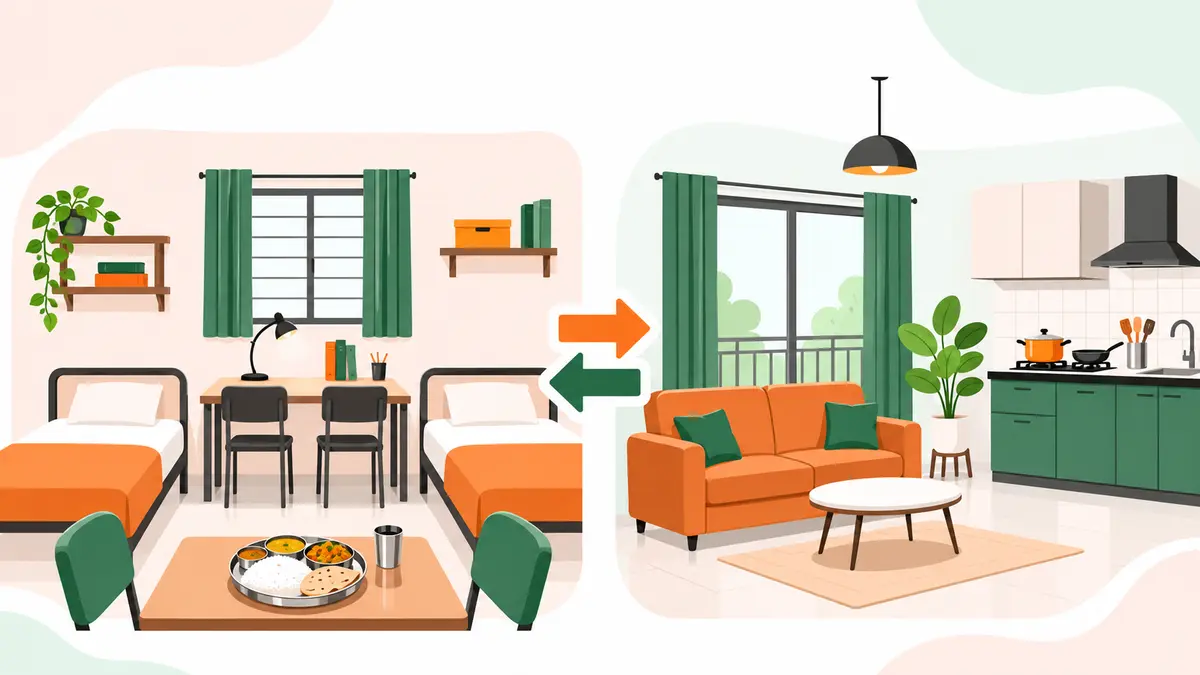
In the PG vs flat decision, a PG (paying guest accommodation) usually wins if you’re new to a city, staying alone, and want to start with as little hassle and upfront money as possible. If you plan to stay a year or more, want privacy, cook your own food, or can share with one or two flatmates, a rented flat usually works out better, and often cheaper per person.
That’s the short version of the PG vs flat question. The real answer depends on how long you’ll stay, your budget for the first month, food, privacy and how much household work you’re willing to take on. Here’s how each one plays out. Once you’ve decided, our complete guide to renting a house in India covers the rest of the process.
PG vs flat: the quick comparison
| Factor | PG | Rented flat |
|---|---|---|
| Upfront money | Low: usually one or two months’ deposit, no furniture to buy | High: deposit, often a broker’s fee, furniture and appliances |
| Monthly cost | Fixed, often includes food, Wi-Fi, cleaning and electricity up to a limit | Rent plus maintenance, utilities, internet, groceries and help |
| Food | Usually included (two or three meals) | You cook, hire a cook or order in |
| Privacy | Limited: shared rooms are common, and there are house rules | Your own space; you set the rules with flatmates |
| Flexibility | Easy to leave with a short notice period | Lock-in and notice periods are common; agreement usually for 11 months |
| Paperwork | Simple: ID, photos, sometimes police verification | Rent agreement on stamp paper, police verification, more documents |
| Responsibility | The PG owner handles repairs, cleaning, bills | You handle bills, repairs within your scope, and the household |
| Rules | Entry timings, guest restrictions, no cooking in rooms | Society rules only |
PG vs flat cost: what you actually pay
The monthly PG fee looks higher than a share of rent, which is why people often assume a flat is cheaper. That’s only half the picture. Here’s an example for one person in a mid-sized city. The numbers are illustrative, so plug in your own:
| Monthly cost | PG (twin sharing) | Flat (2BHK shared by two) |
|---|---|---|
| Rent or PG fee | ₹12,000 | ₹10,000 (your half of ₹20,000) |
| Food | Included | ₹5,000 to ₹7,000 (groceries or a cook) |
| Electricity and water | Usually included up to a limit | ₹800 to ₹1,500 |
| Internet | Included | ₹400 to ₹600 (your share) |
| Cleaning or house help | Included | ₹1,000 to ₹1,500 (your share) |
| Society maintenance | Included | ₹500 to ₹1,000, if the landlord passes it on |
| Approximate total | ₹12,000 | ₹17,700 to ₹21,600 |
In this example, the PG works out cheaper month to month for one person, mainly because food and services are bundled. The flat starts to win when there are three people sharing, when you cook simple meals yourself, or when you’re in a city where PG fees are high relative to rents.
Then there’s the money on day one. A PG typically asks for a deposit of one or two months’ fee.
A flat often asks for a larger deposit, and then you need furniture and appliances, which add up quickly even if you buy second-hand. Spread over 11 months, those costs matter. Spread over three years, much less.
One point on deposits: in states that have adopted the Model Tenancy Act, the deposit for residential property is capped at two months’ rent. In other states, it’s whatever you agree with the landlord, so negotiate before signing.
Food: often the deciding factor
For many people, food decides the PG vs flat question. A PG’s meals save time and remove a daily decision, which is a big relief when you’re working long hours or studying. The trade-off is that you eat what’s cooked, at the times it’s served, and quality varies a lot from one PG to the next.
In a flat, you control what you eat. That’s great if you cook or keep odd hours. It’s also the biggest hidden cost if you end up ordering in most nights. Be honest with yourself about which person you’ll be.
Before you choose a PG, eat at least one meal there. Ask current residents about the food on a normal weekday, not what’s served when visitors come.
Privacy, freedom and rules
Rules are a big part of the PG vs flat choice, and PGs come with plenty. Common ones include entry timings at night and limits on guests, especially of the opposite gender. Cooking in rooms is usually banned too.
For some people, that’s a comfort. For others, it’s the reason they move out after three months.
A flat gives you your own front door. You still have to follow society rules, and you’ll need to get along with flatmates, but you decide who visits and when you come home. If privacy or flexible hours matter to you, a flat is the better long-term choice.
Room sharing matters too. Twin or triple sharing is common in PGs and keeps the cost down. Single rooms exist but cost noticeably more, which can close the gap with a shared flat.
Paperwork and safety
A PG usually needs only ID proof, photos and a deposit, plus police verification in many cities. A flat needs a proper rent agreement on stamp paper, with registration if it runs longer than 11 months, and a longer list of documents for tenants and owners.
Whichever you choose, tenant details often have to be submitted to the police. The landlord or PG owner usually files it through the state police website, such as the Delhi Police citizen services or UP Police citizen services.
For PGs specifically, check:
- That there’s a written receipt or agreement for the deposit and monthly fee.
- Fire safety basics: working extinguishers, a clear exit, no overloaded wiring.
- CCTV at the entrance and a working lock on your room or cupboard.
- What happens to your deposit if you leave early, and the notice period.
- Whether electricity is included fully or only up to a limit, since AC use can mean extra charges.
Who should choose a PG
A PG makes most sense if you are:
- Moving to a new city for a job or course and don’t know the areas yet.
- Planning to stay for a few months, or unsure how long you’ll stay.
- Short on upfront money for a deposit and furniture.
- Not interested in cooking or managing a household.
- A student who wants a structured, supervised place to live.
Many people start in a PG for their first three to six months, learn the city, find flatmates, and then move into a flat. It’s a sensible way to avoid locking into the wrong neighbourhood.
Who should choose a flat
A flat is usually the better choice if you:
- Plan to stay a year or longer.
- Have one or two people to share with.
- Want privacy, guests and your own routine.
- Cook, or have specific food needs.
- Work from home and need a quiet room and reliable internet you control.
If you’re moving with family, a flat is the only practical option.
PG vs flat: questions to ask before you decide
- How long will I realistically stay in this city or area?
- How much can I pay upfront, not just monthly?
- Will I cook, or will food be the expense that sinks my budget?
- Do I have reliable flatmates, or would I be renting alone?
- How much do house rules bother me?
If most answers point to short stay, low upfront money and no cooking, go with a PG. If they point to long stay, sharing and independence, look for a flat.
Frequently asked questions
Is a PG cheaper than a flat?
For one person, often yes, once you count food, cleaning and utilities that a PG includes. With two or three people sharing a flat and cooking at home, the flat is often cheaper per person.
Do I need a rent agreement for a PG?
Many PGs use a simple written agreement or receipt rather than a stamped rent agreement. Ask for written terms covering the deposit, monthly fee, notice period and refund, and keep payment records.
Can I shift from a PG to a flat later?
Yes, and it’s common. Check the PG’s notice period so you don’t lose part of your deposit, and line up the flat’s agreement and police verification before you move.