
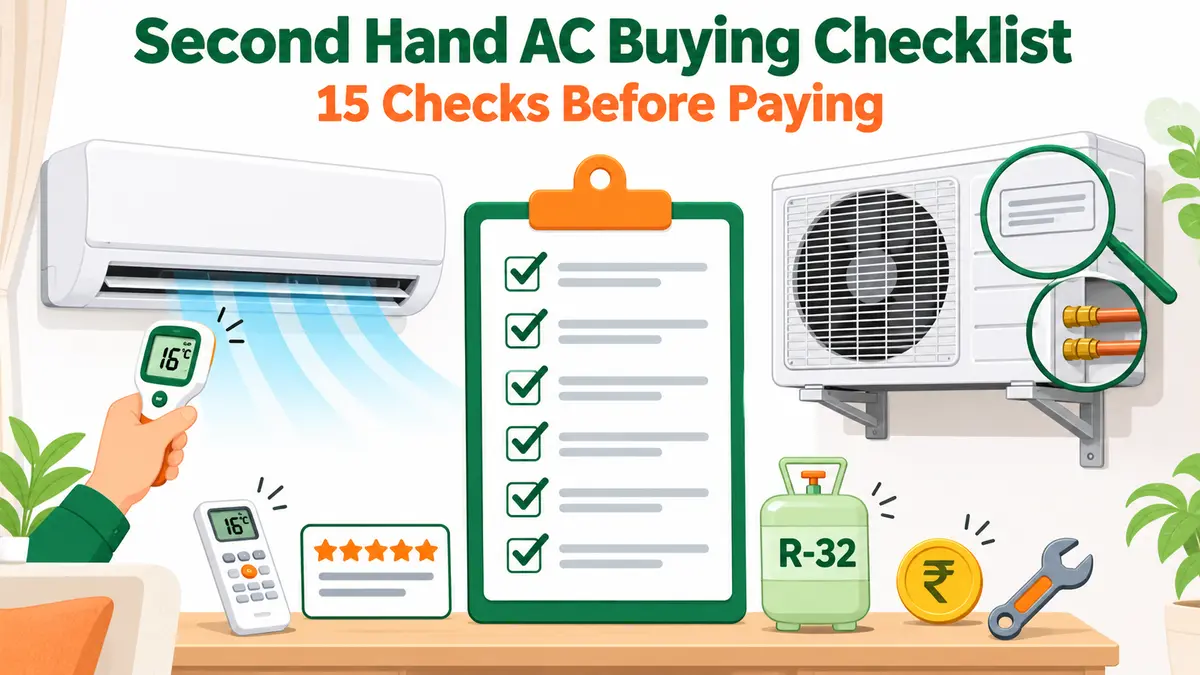
Use this second hand AC buying checklist before you pay anyone in India, whether the seller is a neighbour, a classifieds listing or a local shop. A used AC can save you half the price of a new one. It can also hand you a dying compressor, an outdated gas and an installation bill nobody mentioned.
The 15 checks below take about 30 minutes at the seller’s place. You need a digital thermometer, a torch and the patience to let the AC run for 20 minutes before you judge it. After the checklist, you’ll find the parts other guides skip: how ACs get dressed up for sale, what goes wrong during the move, and the tests a technician uses.
Is a second hand AC worth buying at all?
It can be, under three conditions: the AC is less than about six years old, it uses a current refrigerant gas, and the seller lets you run it properly before you pay.
The catch is that the purchase price isn’t the full cost. Uninstalling, transporting, reinstalling, a gas top-up and possibly new copper piping all come on top. Add those up first, then compare the total with a new budget AC on EMI. If the gap is small, the new AC wins, because it comes with a full warranty and better efficiency.
Window ACs are usually the safer second hand buy. They have no gas pipes to cut and rejoin, so shifting one is simple and cheap. A split AC has to be uninstalled and reinstalled by a technician, and that’s where most problems start.
Window, split or inverter? It depends on how you’ll use it
Most advice says “buy inverter” or “buy 5-star” as if everyone uses an AC the same way. They don’t, and the right second hand buy changes with your situation.
How many hours it will run. If the AC runs two or three hours on summer nights, the electricity difference between a 3-star and a 5-star, or between fixed-speed and inverter, stays small. A cheaper fixed-speed AC can be the smarter buy. At eight to ten hours a day (working from home, elderly parents at home all afternoon), efficiency pays back quickly and an inverter earns its higher price.
How often you move. Every split AC move means uninstalling, reinstalling, a possible gas top-up and the risks covered later in this guide. A window AC moves with almost no cost or risk. If you shift rented homes every 11 months, a window AC can beat a “better” split AC over three years.
Where you live. Salty air in coastal cities like Mumbai, Chennai or Kochi corrodes coils and outdoor bodies faster, so coil condition matters more there. In dusty north Indian cities, a choked coil is the more common problem, and a deep clean usually fixes it.
How long you need it. For one summer (a student, a short posting), buy a cheap, working AC you can resell in September. Efficiency hardly matters. Resale value does.
| Your situation | Best second hand buy |
|---|---|
| Tenant, moving every year | Window AC |
| Light use, a few hours a night | Fixed-speed split or window, priced low |
| Heavy use, 8+ hours a day | Inverter split, under five years old |
| Coastal city | Any type, but only with a clean, uncorroded coil |
| One summer only | Cheapest working AC with good resale value |
A simple break-even test settles close calls. Add the price, moving and installation, likely repairs and electricity for the years you’ll use it, then subtract what you expect to resell it for. Do the same sum for a new AC on no-cost EMI. The smaller number wins.
Before you visit: three questions on the phone
Ask these first. The answers will rule out half the listings.
- How old is it, and do you have the bill? A seller who doesn’t know the year is usually selling something older than they’d like to admit.
- Is it inverter or non-inverter, and how many tons?
- Is it still installed and running? You want to see it working on the wall, not packed in a corner.
If the AC is already uninstalled, you can’t test cooling. Either ask the seller to arrange a test, or treat the price as if the AC might need repairs.
The paperwork and label checks (1 to 5)
1. Check the age on the nameplate
Every AC has a sticker on the indoor and outdoor units with the model number, serial number and usually the month and year of manufacture. Photograph both stickers. They should show the same brand and matching model series.
An AC has a working life of roughly ten years with good care. At six or seven years, you’re buying the expensive half of that life, when compressors and circuit boards start to fail. My rule: don’t pay more than token money for anything older than seven years.
2. Ask for the bill and check the warranty
The original bill proves the age and shows the seller bought the AC legally. It also tells you about the warranty. Many brands give a longer warranty on the compressor than on the rest of the AC, sometimes five or ten years.
Find out whether that warranty transfers to a new owner. Some brands allow it with the bill and some refuse, so check on the brand’s official website or customer care before you count it as part of the value.
3. Read the star label, and its year
The Bureau of Energy Efficiency (BEE) star label shows how efficient the AC was when it was sold. Look at the year printed on the label too, not just the stars.
BEE tightens the star standards from time to time. A 5-star AC from several years ago may match only a 3-star or 4-star model by today’s table. So “5-star” on an old AC tells you it was efficient for its time, nothing more.
The label also shows the estimated yearly electricity use in units. Multiply that by your electricity rate and you’ll know roughly what it costs to run each year.
4. Inverter or non-inverter?
An inverter AC adjusts its compressor speed instead of switching fully on and off, so it usually uses less power and holds the temperature more evenly. It also has a more complex circuit board, and that board is the most expensive part to replace after the compressor.
For a second hand buy, an inverter AC under five years old is a good deal. An old inverter AC with no warranty is a gamble, because a single board failure can cost a big share of what you paid.
5. Match the tonnage to your room
Buying the wrong size is a common mistake with used ACs, because people buy whatever is available. A rough guide for Indian homes:
| Room size | Tonnage |
|---|---|
| Up to about 120 sq ft | 0.75 to 1 ton |
| 120 to 180 sq ft | 1.5 ton |
| Above 180 sq ft | 2 ton |
Go one size up for a top-floor room, a west-facing room or a kitchen-adjoining room. A small AC in a big room runs flat out all day and still won’t cool it.
The outdoor unit (6 to 10)
The outdoor unit holds the compressor, which is the heart of the AC and the most expensive part. Spend most of your inspection time here, because a compressor that fails in its first summer with you can cost more to replace than you paid for the whole AC.
6. Check which refrigerant gas it uses
The gas type is printed on the outdoor unit’s nameplate. You’ll usually see R-22, R-410A, R-32 or R-290.
R-22 is an older gas that India is phasing out under the Montreal Protocol, because it damages the ozone layer. ACs using it still work, but refilling them is getting harder and costlier over time. Newer ACs use R-32, R-410A or R-290. An R-22 AC should be priced well below one with a current gas.
7. Listen to the compressor
Switch the AC on and stand near the outdoor unit. The compressor should start within a few minutes with a steady hum.
Warning signs:
- Loud clanking, grinding or rattling.
- The compressor starting, stopping and restarting every few minutes.
- The whole unit shaking on its stand.
- A burning smell or very hot casing.
A noisy fan is a cheap fix. A noisy compressor is not.
8. Look at the condenser coil
The coil is the grid of thin metal fins on the outdoor unit. Check whether it’s copper or aluminium. Copper is easier to repair and handles corrosion better, especially near the sea. The spec sheet or nameplate usually says which.
Then look at its condition with a torch. Heavily bent or flattened fins, green or white corrosion, and thick dirt packed into the grid all reduce cooling. Light dust is normal and cleans off.
9. Look for signs of a gas leak
Check the pipe joints and valves where the copper pipes enter the outdoor unit. Oily stains there often mean gas is leaking with the compressor oil.
Ask the seller how often they’ve had to refill gas. Once in several years is normal after shifting. Every summer means a leak someone keeps topping up instead of fixing.
10. Check the body, stand and fan
Rust on the outdoor unit’s body, especially at the base, shortens its life. Check that the fan spins freely and the stand isn’t corroded through. A unit that has stood on a sunny terrace for years with no shade will usually show it.
The indoor unit and the cooling test (11 to 15)
11. Run the cooling test with a thermometer
This is the single most useful check on this list. Set the AC to its lowest temperature and highest fan speed, close the door and windows, and wait 15 to 20 minutes.
Then measure two temperatures with a digital thermometer: the air going into the indoor unit (at the top or front grille) and the air coming out of the vents. A healthy AC usually shows a difference of roughly 8 to 12 °C. A difference of only 3 or 4 degrees points to low gas, a weak compressor or a choked coil.
Also check the room actually feels cool after 20 minutes. Your hand is a poor judge on a hot day, which is why the thermometer matters.
12. Check for water leaks and smells
Water dripping from the indoor unit onto the wall usually means a blocked drain pipe or a tilted installation. It’s fixable, but it’s also a sign of poor maintenance.
A musty smell when the AC starts points to mould on the coil or filter. Open the front panel and look at the filter and the coil behind it. Black spots or a slimy coil need a deep service before you use it.
13. Test the remote, display and every mode
Try cooling, fan, dry and sleep modes. Change the temperature up and down and check the display responds. Move the louvers (the swinging flaps) and check they swing fully.
If an error code flashes on the display, note it and search the brand’s manual. Sellers often reset an AC so the code clears just before you arrive, which is another reason to run it for 20 minutes.
14. Ask about repairs and service history
Ask directly: has the compressor, circuit board (PCB) or fan motor ever been replaced? Who did the work, an authorised service centre or a local mechanic?
A compressor replaced at an authorised centre, with a bill to prove it, is fine, and it may even carry a fresh warranty of its own. A replaced board from an unknown shop is a reason to lower your offer.
15. Work out what installation will cost
Before you agree a price, ask a technician for a quote covering:
- Uninstalling from the seller’s home.
- Transport.
- Installation at your place, including a wall stand or outdoor stand if needed.
- Extra copper pipe if your outdoor unit sits further from the indoor unit than the old setup.
- A gas top-up, which is common after shifting a split AC.
- A stabiliser, if the seller isn’t including one.
Add these costs to the asking price. That total, not the asking price alone, is what you compare with a new AC.
How second hand ACs get dressed up for sale
A good demo can be staged. These are the tricks experienced technicians see again and again, and the paperwork usually gives them away.
| What’s done | Why | How to spot it |
|---|---|---|
| Gas topped up just before the sale | A leaking AC cools perfectly for the demo, then fades within weeks | A very recent refill with no repair bill explaining why it was needed |
| Outdoor unit freshly painted | Hides rust and corrosion | Paint over the nameplate, overspray on screws, an “old” unit that looks new |
| Indoor and outdoor units from different ACs | Two broken ACs combined into one that runs | Model numbers on the two nameplates don’t belong to the same series or capacity |
| Universal circuit board fitted | Cheaper than the brand’s original board | A generic “universal” remote instead of the brand’s own; some modes or error codes don’t work |
| Compressor replaced with a non-original one | Cheaper repair | New mounting bolts, fresh tape on terminals, a compressor label that doesn’t match the brand |
None of these is automatically a deal breaker. A replaced part with a proper bill can be fine. What should worry you is a recent repair or refill that the seller didn’t mention until you asked.
Why an AC that cooled perfectly at the seller’s home can fail at yours
The inspection only proves the AC worked where it was. With a split AC, the move is a second risk, and it’s the one every other checklist ignores. Most of the damage happens in three steps, and you can control all of them by asking the right questions.
At uninstall: ask for a pump-down
Before disconnecting the pipes, a good technician runs a “pump-down”: the gas is pushed back into the outdoor unit and its service valves are closed, so the gas stays inside. Skip this, and the gas escapes into the air and you pay for a full refill at your end. Ask for it by name.
At reinstall: insist on vacuuming
Once the pipes are open, moist air gets in. After reconnecting, the technician should pull a vacuum on the lines with a vacuum pump before releasing the gas. Without it, that moisture mixes with the gas and compressor oil and quietly shortens the compressor’s life. It’s the step most often skipped, because it takes time and equipment.
Ask the technician whether they’ll use a vacuum pump, and watch for it. Also ask them to check the flare joints (the connections at each pipe end) for leaks before they leave.
At the new site: placement, pipe length and voltage
- Pipe length. Moving the outdoor unit further away than before, or adding several bends, can mean the gas charge needs adjusting. A long, twisted run cuts cooling even on a healthy AC.
- Outdoor unit placement. Inside an enclosed balcony, under a tin shed, too close to a wall or in full afternoon sun, the unit breathes its own hot air back in. Cooling drops and the compressor runs hotter.
- Voltage. The seller’s ground-floor flat may have had steady power. If your top-floor flat or locality sees frequent fluctuations, an old fixed-speed compressor faces low-voltage starts. That’s where a stabiliser earns its cost.
Going further: technician-level tests
This part goes beyond the basic second hand AC buying checklist. It’s for readers who already know the basics, or for anyone buying several ACs (a PG owner fitting rooms, a small reseller). A technician can run these tests in one visit, and the visit costs far less than a compressor.
Running current with a clamp meter
The nameplate lists the AC’s rated current. After 15 to 20 minutes of running, clamp a meter on the supply line and compare. A reading well below the rated figure, together with weak cooling, often points to low gas. A reading well above it suggests a struggling compressor, a choked condenser or low supply voltage.
Suction pressure with a gauge
A technician can connect a pressure gauge to the service port on the outdoor unit. The correct range depends on the gas type and the outdoor temperature, so it has to come from the gas specification or the brand’s service data. No single number fits every AC. This is the only direct way to confirm the gas charge.
Reading the cooling test in context
The temperature drop at the vent depends on humidity and outdoor heat. On a humid monsoon day it naturally looks smaller, because the AC spends part of its effort pulling moisture out of the air. Read the vent drop together with the running current, never alone.
Insulation and earthing
Check that the copper pipes are insulated along their full length. Bare pipe sweats, drips down the wall and wastes cooling. Confirm the socket is properly earthed too. An old AC with an internal fault and no earthing is a safety risk, whatever its price.
The three-reading rule
| Reading | Normal | Warning |
|---|---|---|
| Vent temperature drop | Roughly 8 to 12 °C in normal conditions | Only a few degrees |
| Running current | Close to the nameplate rating | Far below (with weak cooling) or far above |
| Suction pressure | Within the range for that gas and outdoor temperature | Clearly outside it |
Two normal readings out of three, at a fair price, is acceptable. Fewer than two, walk away. Turned into a routine, this makes buying several ACs predictable instead of a gamble on each one.
What to pay, and how to pay safely
A used AC’s fair price depends on age, gas type, inverter or not, condition and how much installation will cost you. Check what similar models of the same age sell for in your city on classifieds, ignore the highest asking prices, and use anything you found in the checks above to negotiate.
When it comes to payment:
- Never pay an advance to “book” an AC you haven’t seen running.
- Pay by bank transfer or UPI once you’re satisfied, and check the seller’s name matches.
- Never scan a QR code or approve a UPI request from someone who says they’re paying you. Scanning sends money out of your account. Sellers face the same trick, as our guide on how to sell old phone safely explains.
- Get a simple written receipt with the brand, model, serial number, price and date.
If you lose money to a scam, call the national cybercrime helpline 1930 or report it at cybercrime.gov.in.
Buying from a shop instead of a person
Second hand and refurbished AC shops are common in most cities. They usually charge more than a private seller but may include installation and a short shop warranty, often a few months.
Get that warranty in writing on the bill, with the serial number, and ask what it covers. A shop warranty that covers gas and service but excludes the compressor and PCB covers the cheap parts and skips the expensive ones.
Second hand AC myths vs reality
Some of the most repeated AC advice leads buyers to overpay, pick the wrong size or miss a leak.
| Myth | Reality |
|---|---|
| An AC needs a gas refill every year | The gas runs in a sealed loop. A healthy AC can go years without a refill. A yearly refill means a leak nobody has fixed. |
| A bigger tonnage cools better | An oversized AC cools quickly and shuts off before it removes humidity. The room feels cold and clammy, and frequent starts wear the compressor. |
| Setting 16 °C cools the room faster | The compressor works at the same rate whatever you set. A lower setting only makes it run longer and overshoot, using more power. |
| A 5-star label means low bills | It depends on the label’s year and on how many hours you run it. For light use, the saving over a 3-star is small. |
| Inverter ACs never need a stabiliser | Many inverter models handle a wider voltage range, but it varies by model. Check the manual’s operating range against your area’s supply. |
| Refurbished means good as new | There’s no standard definition. It can mean a full overhaul or a coil wash and fresh paint. The written warranty tells you more than the word. |
| If it cools well at the seller’s, it will cool well at home | The move itself can cause problems: lost gas, moisture in the lines, a badly placed outdoor unit. |
Second hand AC buying checklist on one page
Screenshot this second hand AC buying checklist and keep it open on your phone at the seller’s place.
| # | Check | Pass if |
|---|---|---|
| 1 | Age on nameplate | Under 6 to 7 years |
| 2 | Bill and warranty | Bill available; compressor warranty status known |
| 3 | Star label | Label present; year noted |
| 4 | Inverter or not | Inverter under 5 years, or fixed-speed priced lower |
| 5 | Tonnage | Matches your room size |
| 6 | Gas type | R-32, R-410A or R-290 preferred; R-22 priced lower |
| 7 | Compressor | Steady hum, no clanking or frequent restarts |
| 8 | Condenser coil | No heavy corrosion or crushed fins |
| 9 | Gas leak | No oily joints; no yearly refills |
| 10 | Body and fan | No deep rust; fan spins freely |
| 11 | Cooling test | Roughly 8 to 12 °C difference after 20 minutes |
| 12 | Water and smell | No dripping, no musty smell |
| 13 | Remote and modes | All modes and the display work; no error codes |
| 14 | Repair history | Major repairs done at an authorised centre |
| 15 | Installation cost | Quoted and added to the price |
| Bonus | The move | Pump-down at uninstall, vacuuming at reinstall |
Frequently asked questions
What is the 3 minute rule for AC?
After you switch an AC off, wait about three minutes before switching it on again. This gives the pressure inside the system time to settle, so the compressor doesn’t start under strain. Many ACs have a built-in delay for the same reason.
What is the 20 rule for air conditioners?
It’s a rule of thumb to keep the indoor temperature within about 20 °F (around 11 °C) of the outdoor temperature. Setting the AC much colder than that makes it run constantly without cooling much further. In India, a setting around 24 to 26 °C is comfortable for most people and easier on the bill.
Is refurbished better than second hand?
A refurbished AC from a shop has usually been serviced and may carry a short warranty, which a private sale doesn’t. It also costs more. Run the same checks on both, because “refurbished” has no fixed meaning.
Should I buy a second hand AC in winter?
It’s the best time on price, since demand drops after the summer. The downside is that a cold day makes the cooling test harder to judge, so rely on the thermometer reading rather than how the room feels.