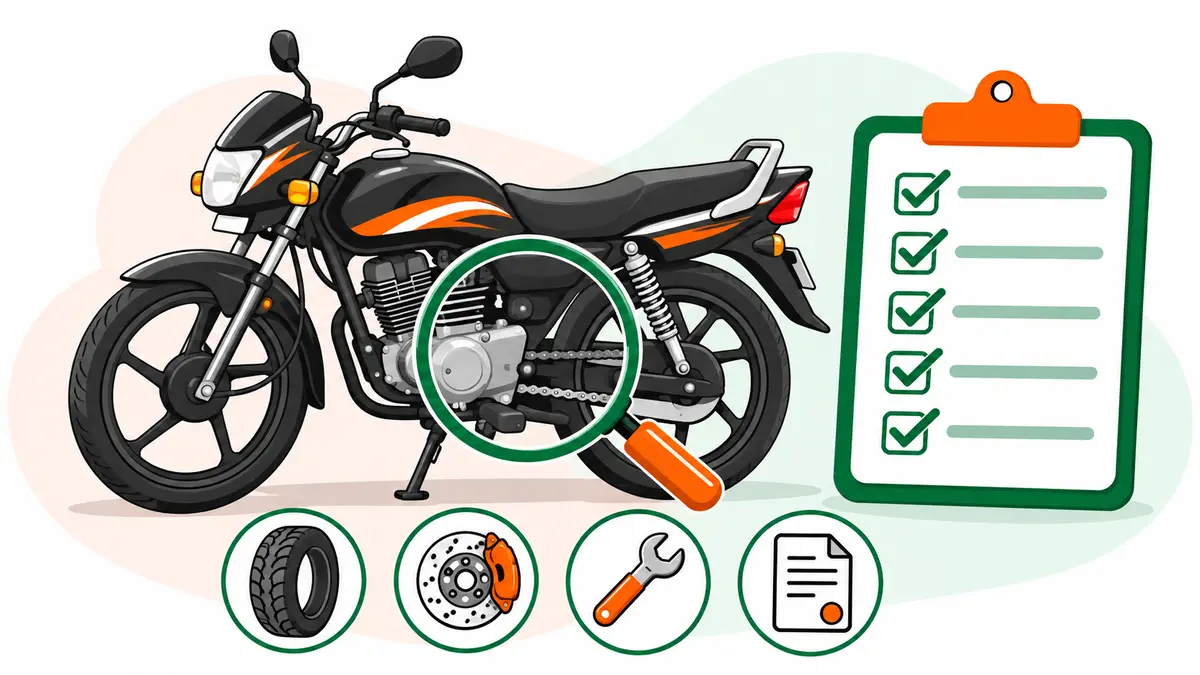
A second hand bike can look perfect on a WhatsApp photo and still hide a loan, a pending challan or a worn-out clutch. This used bike buying checklist covers the 15 checks worth doing before any money changes hands: five on paper, eight on the bike itself, and two on the test ride.
Take it with you on your phone. Most of these checks need nothing more than a torch, ten minutes and the seller’s patience. For the full buying and selling process, see our complete guide to buy used car or bike in India.
Second hand bike documents first: checks 1 to 5
Do these before you even look at the used bike closely. If the papers fail, nothing else matters.
1. Match the RC with the bike
Read the chassis number and engine number on the bike and compare them, digit by digit, with the RC (registration certificate). The chassis number is usually stamped near the steering head; the engine number is on the engine casing. If the numbers are scratched, repainted or don’t match, walk away.
2. Look the bike up on Vahan
Enter the registration number on the mParivahan app or the Vahan “Know your vehicle details” service. Check that:
- The owner’s name matches the person selling to you.
- The registration date, fuel type and model match what you’ve been told.
- The insurance and PUC dates are current.
- No financier (bank) is listed. If one is, the loan must be closed and you need the bank’s NOC and Form 35 before you pay.
If the seller isn’t the registered owner (for example, a “friend’s bike” or a dealer selling on someone’s behalf), be extra careful and insist the registered owner signs the transfer forms.
3. Check for pending challans
Search the registration number on the Parivahan e-challan portal or your state traffic police website. Unpaid challans stay with the vehicle, and you don’t want to inherit someone else’s fines. Agree in writing that the seller clears them before the sale.
4. Make sure it isn’t stolen
The National Crime Records Bureau runs Vahan Samanvay, a database of stolen and recovered vehicles from across India, launched in 2016. Some state police websites also offer a stolen vehicle search. A price far below the market for a recent model is the biggest warning sign of all.
5. Ask for the service record and both keys
A service booklet or app history with regular entries tells you the bike was looked after and helps confirm the odometer reading. A missing second key isn’t a dealbreaker, but it’s a fair reason to negotiate, since a replacement key and lock set costs money.
On the used bike itself: checks 6 to 13
Look at the used bike in daylight, ideally when the engine is cold. A seller who has “just warmed it up for you” may be hiding a starting problem.
6. Cold start
Ask the seller not to start the bike before you arrive. A healthy bike should start on the first or second try, whether by self-start or kick. Listen for knocking or rattling in the first few seconds. A guide on BikeAdvice suggests a cold engine shouldn’t need more than two kicks.
7. Exhaust smoke
Rev the engine a little and watch the exhaust:
| Smoke colour | What it usually means |
|---|---|
| None or thin, clear vapour | Normal |
| Blue or grey | Engine burning oil (worn rings or valve seals); expensive to fix |
| Thick white that doesn’t clear | Possible coolant or water getting into the engine |
| Black | Fuel mixture too rich; often a tuning or air filter issue |
A little white vapour on a cold morning is normal and disappears quickly. Blue smoke is the one to take seriously.
8. Engine oil
Check the oil through the sight glass or dipstick. It should be within the marks and look brown, not milky. White streaks or a milky look can mean water has got in.
9. Chain and sprockets
Look at the teeth on the rear sprocket. Pointed, hooked or uneven teeth mean the chain and sprocket set is worn and will need replacing soon, which is a common hidden cost. Lift the chain at the middle of its lower run: a chain that moves far more than the slack your owner’s manual specifies, or a chain with tight and loose spots, is worn.
10. Tyres
Check the tread depth and look for cracks on the sidewalls. Then find the four-digit date code on the tyre: the first two digits are the week and the last two are the year of manufacture, so 2321 means the 23rd week of 2021. Rubber hardens with age even if the tread looks fine.
11. Brakes
Squeeze the front brake lever and press the rear pedal. They should feel firm, not spongy, and the wheel shouldn’t drag after you release them. On disc brakes, check the pad thickness and look for oil or fluid leaks around the calliper.
12. Suspension and frame
Push down hard on the handlebar and then on the seat. The bike should bounce back once, smoothly. Oil on the front fork tubes means a leaking seal. Look along the frame and fork for bends, fresh paint in odd places or new parts on just one side, which usually point to an accident.
13. Lights, horn and electricals
Test the headlight on low and high beam, indicators, brake light (with both brakes), tail light, horn and self-start. Check the battery terminals for corrosion. Electrical faults are rarely expensive individually, but several together suggest neglect.
The test ride: checks 14 and 15
14. Ride it yourself, for longer than a lap
Ride for at least 15 to 20 minutes, with some slow traffic and an open stretch if possible. Watch for:
- Gears that slip, jump into neutral or are hard to shift (especially first to second).
- A clutch that slips, so the engine revs rise but the bike doesn’t speed up.
- The bike pulling to one side when you briefly loosen your grip on a straight road, which points to bent forks or wheel alignment problems.
- Vibrations through the handlebar or footpegs at steady speeds.
- Odd noises from the engine or suspension over bumps.
Check that the speedometer and odometer move as you ride. Compare the odometer reading with the bike’s age and the service record. A five-year-old daily commuter showing only a few thousand kilometres deserves questions, because odometers on older bikes can be tampered with or replaced.
15. Get a mechanic’s opinion
If you’re not confident, take the bike to a mechanic you trust, or bring a friend who knows bikes. Many local mechanics will inspect a used bike for a small fee, which is cheap insurance against a bad engine or a hidden accident. A seller who refuses an inspection is telling you something.
What should you pay for a used bike?
Check what the same model, year and city sells for on classifieds and used two-wheeler platforms, and ignore the most hopeful asking prices. The IDV on the bike’s insurance policy is a useful sanity check too. Insurers calculate it from the showroom price minus a fixed depreciation by age, from 5% for a bike under six months old to 50% for one that’s four to five years old, according to the standard IDV depreciation schedule. Whatever the checklist turned up (a worn chain set, old tyres, a missing key) is a fair reason to ask for less.
Before you hand over the money
Once the used bike passes, close the deal properly:
- Agree on the price, and who pays for pending challans or any repairs you found.
- Pay by bank transfer and keep the record. Don’t pay cash in full without a receipt.
- Sign a simple sale or delivery note with the bike’s registration, chassis and engine numbers, the price, and the date and time of handover.
- Collect the original RC, insurance papers, PUC, service record and both keys.
- Fill in Forms 29 and 30 together and apply for the transfer the same day, while the seller’s registered mobile is at hand for the OTP.
The RC transfer process in India has the full steps, documents and fees. Don’t ride for long with the bike in the old owner’s name: the insurance policy also needs to move to your name, and until it does, a claim can get complicated.
If you’re on the other side of the deal, our guide on how to sell a used car in India covers safe payments and paperwork, and the same rules apply to selling a bike.
The checklist on one page
Save or screenshot this table and tick it off at the seller’s place.
| # | Check | Pass if |
|---|---|---|
| 1 | Chassis and engine numbers | Match the RC exactly |
| 2 | Vahan lookup | Owner, model and dates match; no financier listed |
| 3 | Challans | None pending, or seller agrees to clear them |
| 4 | Stolen vehicle check | No record; price not suspiciously low |
| 5 | Service record and keys | Regular service entries; both keys present |
| 6 | Cold start | Starts in one or two tries, no knocking |
| 7 | Exhaust smoke | No blue smoke; no thick white smoke |
| 8 | Engine oil | Within the marks, not milky |
| 9 | Chain and sprockets | Teeth not hooked; slack within the manual’s range |
| 10 | Tyres | Good tread, no cracks, date code not too old |
| 11 | Brakes | Firm, no drag, no leaks |
| 12 | Suspension and frame | Smooth rebound, no fork leaks, no bends |
| 13 | Lights and electricals | Everything works, battery terminals clean |
| 14 | Test ride | Smooth gears and clutch, runs straight, no odd noises |
| 15 | Mechanic’s opinion | No major faults found |
Frequently asked questions
What is a good mileage for a used bike?
There’s no fixed number. A well-serviced bike with higher kilometres is usually a better buy than a neglected one with low kilometres. Use the service record and the condition checks above rather than the odometer alone.
Is it safe to buy a used bike from OLX or other classifieds?
It can be, if you meet in person, check the papers against Vahan, inspect the bike and pay only when the paperwork is in order. Never pay an advance to “book” a bike you haven’t seen.
Can I buy a bike that still has a loan on it?
Only once the seller closes the loan and gives you the bank’s NOC and Form 35, so the financier’s name can be removed from the RC.