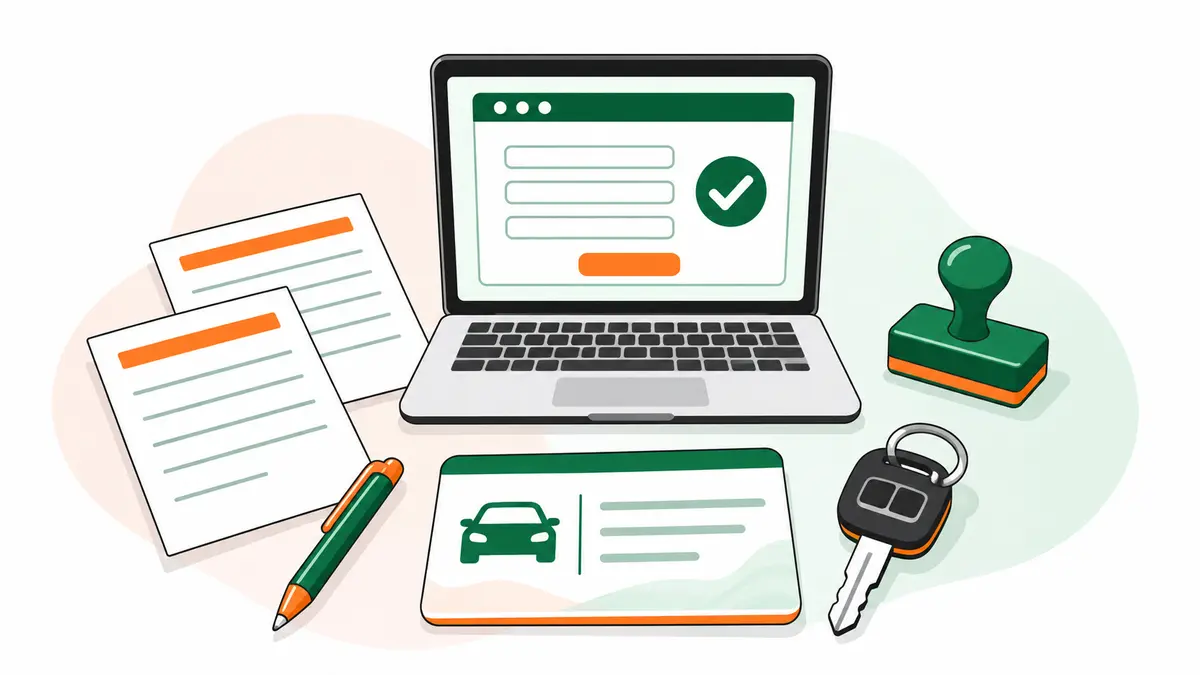
RC transfer is what actually finishes a used vehicle sale. The deal isn’t done when the money changes hands. It’s done when the RTO record shows the buyer’s name, and until then, the law still treats the seller as the owner.
This guide is part of our complete guide to buy used car or bike in India. Here is the full process: which forms you need, what it costs, the time limits, how to apply online on Parivahan, and the special cases (loan on the vehicle, another state, owner passed away).
Why the seller should care more than the buyer
Most people assume RC transfer is the buyer’s headache, on the logic that the buyer wants the vehicle in their name and will sort it out sooner or later. Often they don’t. And the seller pays for it.
Under the Motor Vehicles Act, the “owner” of a vehicle is the person in whose name it’s registered. In Prakash Chand Daga vs Saveta Sharma (2018), a man sold his Santro, handed it over, and the buyer had an accident about four weeks later. The transfer had never been completed in the RTO records. The Supreme Court held the seller liable to the accident victim, even though the accident happened within the reporting window.
So if you’re selling, don’t hand over signed forms and walk away. Stay involved until the transfer is approved. The same logic applies to traffic challans, which go to the registered owner’s address and mobile number.
Time limits under Section 50
Section 50 of the Motor Vehicles Act sets two separate duties:
- Seller (transferor): report the sale to the RTO within 14 days if the vehicle stays in the same state, or within 45 days if the buyer is in another state.
- Buyer (transferee): report the transfer and apply for the new RC within 30 days.
Some state transport departments and many guides simply say “apply within 14 days”. That’s the safe target for both sides. Missing the deadline usually means a late fee, and some states add a penalty.
The insurance policy also needs to move to the buyer’s name. Ask the insurer to do this within 14 days of the transfer, because a policy in the seller’s name can create trouble at claim time.
Forms you’ll need
| Form | What it’s for | Who fills it |
|---|---|---|
| Form 29 | Notice of transfer of ownership | Seller (usually 2 copies) |
| Form 30 | Application for transfer of ownership | Seller and buyer |
| Form 28 | NOC for moving the vehicle to another state or RTO | Seller |
| Form 35 | Notice that a vehicle loan has been closed (hypothecation removed) | Owner and bank |
| Form 31 | Transfer after the owner’s death | Legal heir |
For an ordinary sale within the same state, Forms 29 and 30 are all you need. The other forms only come in for the special cases covered below.
Documents checklist
Requirements vary a little by state, but expect to submit:
- Original RC (registration certificate)
- Valid insurance certificate
- Valid PUC (pollution under control) certificate
- Forms 29 and 30, signed by both parties
- Buyer’s address proof and ID (Aadhaar is the most common)
- PAN card or Form 60 of the buyer
- Pencil print (tracing) of the chassis number, and in some states the engine number
- Passport-size photos of the buyer
- Sale agreement or delivery note (strongly recommended, even where it isn’t mandatory)
- Tax clearance, if the state asks for it
- NOC from the bank and Form 35, if there was a loan on the vehicle
- NOC (Form 28), if the vehicle is coming from another state
Keep photocopies of everything you sign. Sellers should also keep the delivery note, with the exact date and time of handover written on it and signed by the buyer, because that piece of paper is your proof of when the vehicle left your hands.
How to apply for RC transfer online on Parivahan
Since 2021, the Ministry of Road Transport and Highways has allowed many RTO services, including transfer of ownership, to be done online with Aadhaar authentication. How much of it is fully online depends on your state.
The usual flow on the Vahan portal:
- Go to vahan.parivahan.gov.in/vahanservice and choose your state and RTO if asked.
- Enter the vehicle’s registration number.
- Verify using the last five digits of the chassis number and the OTP sent to the mobile number linked to the RC.
- Select Transfer of Ownership.
- Fill in the buyer’s details, upload documents if your state allows it, and pay the fee online.
- Download the receipt and note the application number.
- If your state needs it, book an appointment and visit the RTO with the original documents. Some states also inspect the vehicle.
One practical catch: the OTP goes to the mobile number on the RC, which is the seller’s. If the seller isn’t around, the buyer gets stuck at step 3. That’s one more reason to complete the application together, ideally on the day of the sale.
How to check RC transfer status
Keep the application number from your fee receipt. To check progress:
- Open the Vahan citizen services page and choose Know your application status (some state pages call it application status or “Status”).
- Enter the application number and complete the captcha.
- The page shows which stage the file is at, for example pending verification, pending approval or approved, and whether any document is missing.
If the status hasn’t moved for a few weeks, or it shows that a document is required, contact the RTO with the application number. A quicker cross-check once it’s approved: search the registration number on the mParivahan app and confirm the owner’s name has changed to the buyer’s. That’s the moment the seller can stop worrying.
Once approved, the new RC is printed or issued as a smart card and posted to the buyer’s address.
The offline route at the RTO
If your state hasn’t moved the service fully online, or you prefer to do it in person, the steps are similar:
- Collect Forms 29 and 30 from the RTO or download them from Parivahan, and fill them in with the buyer.
- Attach the documents listed above, with self-attested copies.
- Submit the file at the RTO counter and pay the fee. Keep the receipt.
- If the RTO asks for it, bring the vehicle for inspection by the motor vehicle inspector, who checks the chassis and engine numbers.
- Collect the new RC from the RTO or wait for it by post, as your RTO decides.
Even on the offline route, many RTOs now ask you to generate the application and pay the fee on Vahan first, then visit with the printout.
RC transfer fees: how much does it cost?
The central rules fix the transfer of ownership fee at half the registration fee. That works out to about ₹150 for a motorcycle and ₹300 for a private car.
That’s only the base fee. States add charges for the smart card RC, postage and service fees, so the amount you actually pay is higher. As one example, the Puducherry Transport Department lists ₹500 for a motorcycle and ₹650 for a light motor vehicle. The fee screen on Vahan shows the exact total for your RTO before you pay.
Here is the full central fee schedule for transfer of ownership, which is half the registration fee for each class of vehicle, as listed in the Parivahan fee table compiled by Policybazaar:
| Vehicle type | Transfer of ownership fee |
|---|---|
| Motorcycle (two-wheeler) | ₹150 |
| Private car, non-transport three-wheeler or LMV | ₹300 |
| Transport three-wheeler or LMV (taxi, goods carrier) | ₹500 |
| Medium goods or passenger vehicle | ₹500 |
| Heavy goods or passenger vehicle | ₹750 |
| Imported motorcycle | ₹1,250 |
| Imported car or other imported motor vehicle | ₹2,500 |
Late applications attract a fee too, commonly around ₹300 per month for motorcycles and ₹500 per month for cars.
Agents at the RTO charge on top of all this, and their fees vary widely from city to city. Since most of the official process now runs online, plenty of people manage without one.
Special cases
The vehicle still has a loan on it
The RC carries the bank’s name as financier (this is called hypothecation). Before the transfer:
- Pay off the loan.
- Collect the NOC and Form 35 from the bank.
- Apply to remove the hypothecation, either before the sale or together with the transfer, as your RTO allows.
A buyer should never pay the full amount while the RC still shows a bank’s name and the seller has no NOC.
The buyer lives in another state
The seller first gets an NOC from their RTO using Form 28. The NOC is valid for six months, and it won’t be issued while any challans, tolls or taxes are pending. The buyer then applies in their own state with the NOC and pays road tax there. The seller can ask their original state for a road tax refund under that state’s rules.
The owner has passed away
The legal heir informs the RTO within 30 days of the death and applies for transfer in Form 31 within three months. They’ll need the death certificate and proof of being the legal heir, such as a succession certificate or a no-objection affidavit from the other heirs, depending on the state.
Checks before you sign anything
For the buyer:
- Match the chassis and engine numbers on the vehicle with the RC.
- Look up the vehicle on Vahan or mParivahan to confirm the owner’s name, the registration date and whether a financier is listed.
- Check for pending challans on the state traffic police site or the Parivahan e-challan portal.
- Make sure the insurance and PUC are valid on the day of the sale.
For the seller:
- Clear all pending challans first, or agree in writing who pays them.
- Remove your FASTag or ask the bank to close it after handover.
- Get the buyer’s ID copy and a signed delivery note with the date and time.
- Check the Vahan status a few weeks later. If the transfer hasn’t happened, follow up.
Frequently asked questions
How long does RC transfer take?
After all documents are submitted, most RTOs approve the transfer in a few days to a few weeks. Delivery of the smart card RC by post takes longer, and timelines differ by state.
Can I do RC transfer without visiting the RTO?
In many states, yes, through the Aadhaar-based online service on Vahan. Some states still ask for a physical visit or vehicle inspection, which the portal tells you during the application.
Can the buyer do RC transfer alone?
The buyer can submit Form 30, but the seller has to sign Forms 29 and 30, and online applications need the OTP on the seller’s registered mobile. In practice, both should be involved.
What happens if the RC transfer isn’t done?
The seller stays the legal owner in RTO records. That means challans, and liability for accidents, can still land on the seller, as the Supreme Court case above shows.
Sources
- LiveLaw: Supreme Court on registered owner liability (Prakash Chand Daga vs Saveta Sharma)
- Autocar India: How to transfer vehicle ownership in India
- Autocar India: How to transfer RC from one state to another
- Puducherry Transport Department: Transfer of Ownership
- The Tribune: MoRTH makes 58 RTO services online with Aadhaar authentication
- Policybazaar: Parivahan fees and user charges